Editorial note: This guide draws on conversations with readers over 50 who have used short-format social travel — day trips, walking groups, weekend breaks — as a way to meet people without committing to week-long tours. AARP’s 2026 Travel Trends Survey found that adults over 50 take an average of four trips per year, with 86% rating travel as a priority. A 2024 Royal Society study on social bonding found that sharing emotionally intense experiences with others reinforces social bonds beyond what accumulated hours alone would predict, which helps explain why a single day trip can produce stronger connection than weeks of routine meetings. We are not affiliated with any travel company, tour operator, or activity platform mentioned here.
Tours for singles over 50 usually mean week-long walking holidays or ocean cruises. Formats that assume you are ready to spend significant money, take time off, and share a schedule with strangers for seven consecutive days. For some people, that commitment level feels right. For many others, the sticking point is not the money or the time. It is the thought of being locked into a group that might not suit you, with no easy exit.
That fear is worth naming because it keeps people home. The gap between a weekly book club and a fully organised week abroad is wide, and most of the advice skips the middle. Day trips, walking groups, weekend breaks, and single-day activity classes sit inside that gap. They let you answer a question that no amount of reading brochures can resolve: do I actually enjoy this, or do I just like the idea of it?
This guide covers the main short-format options available to singles over 50, organised from lowest to highest commitment. If you already know you want full group travel, the practical guide to travel groups for singles over 50 covers that territory directly. This piece is for readers still deciding whether group social travel is for them at all.
Why Short Trips Work Differently From Weekly Activities
A regular hobby group puts you alongside the same people for an hour or two each week. Connection builds slowly through repetition: by the sixth session, faces are familiar and conversation feels less forced. The mechanic is gradual familiarity over time.
Short trips compress that differently. A full-day walking group covers six to eight hours of shared experience in a single outing. A weekend break produces more concentrated social contact in 48 hours than a month of weekly classes. The novelty of an unfamiliar setting makes conversation easier because you are all navigating something new together, and nobody has home-ground advantage.
But there is something more useful happening beneath the surface. A weekly class tells you whether you like pottery or Spanish or book discussions. A day trip tells you something about yourself that is harder to learn any other way: how you respond to sustained closeness with strangers when there is no front door to retreat behind. Some people discover they are more sociable than they thought. Others discover they need more solitude than they expected. Both answers are worth having before you spend £2,000 on a week-long group tour.
Research supports the intuition behind this. A 2024 Royal Society study found that sharing emotionally intense experiences with others strengthens social bonds beyond what accumulated contact hours alone would predict. The novelty of being somewhere unfamiliar together, the mild shared vulnerability of navigating a new environment, the small collaborative moments (reading a map, choosing where to eat, commenting on an unexpected downpour) create bonding conditions that a familiar weekly routine cannot replicate. This is why people sometimes feel closer to strangers after one day trip than to acquaintances they have seen at book club for three months.
Think of it as the Saturday test. One well-chosen Saturday can tell you more about your social temperament than months of hypothetical planning. Not whether you enjoy the specific activity, but whether you enjoy being in sustained company. Whether six hours of proximity energises or depletes you. Whether you are the person who gravitates toward the centre of the group or the person who walks contentedly at the back. That self-knowledge has a shelf life far longer than any single trip.
“I did a Ramblers walk along the Medway near Maidstone, just a random Saturday in April,” a 57-year-old reader from Kent told us. “I nearly turned around in the car park. Everyone seemed to know each other already. But by the pub stop at lunchtime I had talked more easily with three or four people than I managed in months of after-work wine bars. I think it was the not-looking-at-each-other part. Walking side by side just… works differently for me.”
That observation about side-by-side versus face-to-face deserves more weight than it usually gets. You are not performing sociability. You are simply sharing a path. The person beside you changes throughout the day as the group stretches and compresses. Conversation comes and goes. Silence is unremarkable. For people who find structured social events draining, the difference is not minor.
The trade-off is real though. A weekly group builds deeper familiarity because you see the same faces repeatedly. A one-off day trip may produce easy conversation that never develops further because you do not encounter those people again. The formats serve different needs, and being honest about which need is more pressing for you right now matters more than choosing the “best” format.
Walking Groups and Outdoor Day Trips
Walking groups are the lowest-cost, lowest-barrier entry point into social travel for singles over 50. Most charge nothing beyond a small annual membership or a modest per-walk contribution for insurance. You show up, you walk, you go home. No booking, no deposit, no awkward cancellation email if you change your mind the night before.
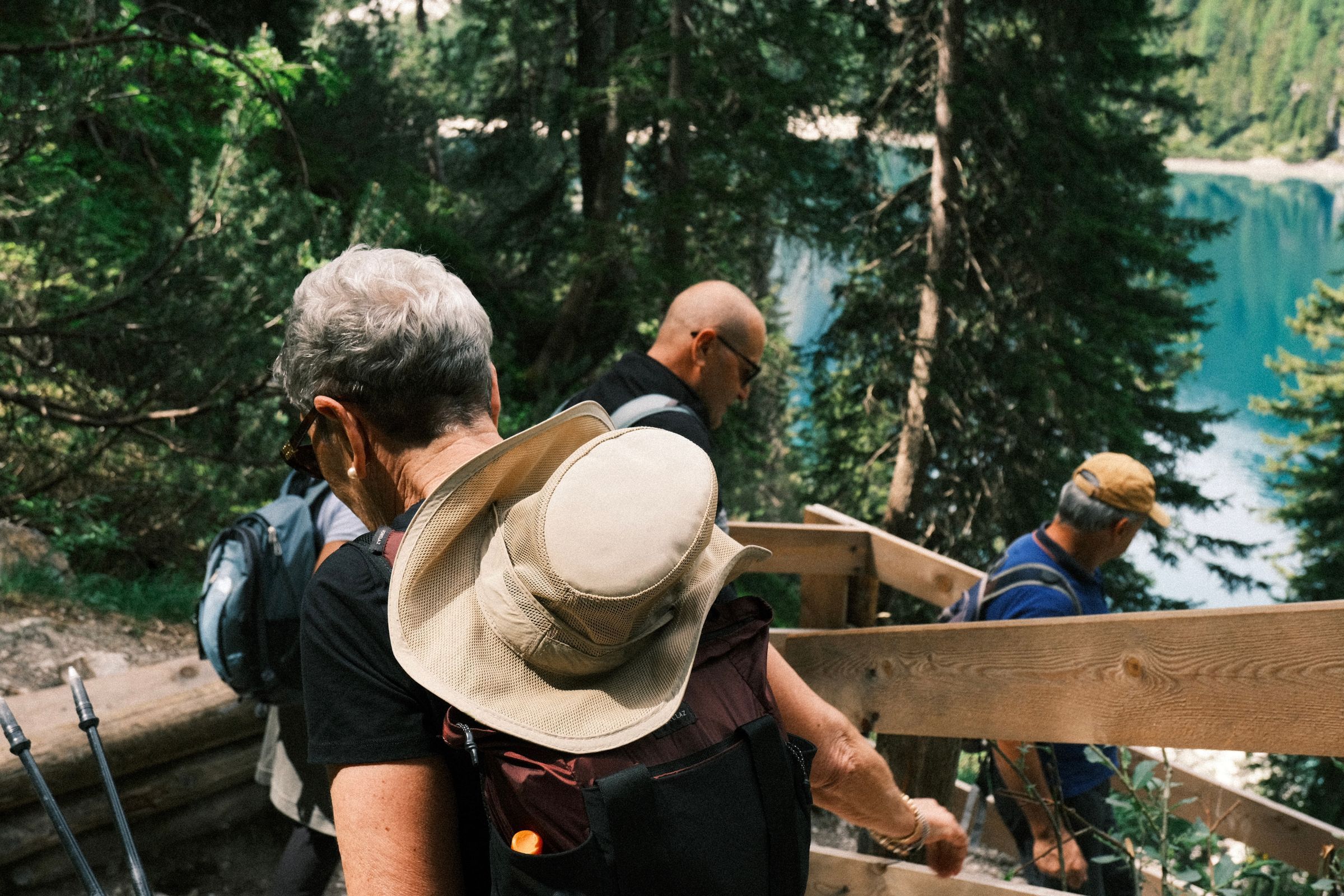
A typical outing is a guided or self-led group walk of 5 to 12 miles, over half a day or a full day. Groups range from 6 to 30 people. Routes are usually graded by difficulty, and most groups stop at a pub or cafe midway for lunch. The social structure is loose by design: walkers naturally sort into smaller clusters of two to four people who share a pace. You might walk in companionable silence for fifteen minutes, then talk for twenty, then fall back and find yourself beside someone new. That rotation is the format’s quiet genius. You never feel trapped in a conversation you cannot exit.
The biggest misconception about walking groups is that they are mainly for fitness. They are not. They are for people who want company but find face-to-face socialising tiring. The side-by-side orientation, the shared landscape, the fact that silence is socially acceptable because everyone is also watching their footing, all of this reduces the performance pressure that makes pub quizzes and wine mixers exhausting for quieter people.
Several national organisations run local groups specifically suited to adults over 50. The Ramblers operates across the UK with thousands of local walking groups. Meetup lists hundreds of walking groups for older adults. Specific singles walking groups exist on both platforms, though many readers find that mixed groups (not exclusively singles) produce more relaxed social dynamics because nobody arrives feeling assessed.
For readers who prefer structured local activities over travel-flavoured ones, the guide to hobbies that help you meet people after 50 covers a broader range of options including choirs, art classes, and gardening groups.
Organised Day Excursions and Activity Classes
A step up in cost and structure from walking groups: paid day trips built around a specific activity. These are usually single-day events costing £30 to £120, run by local operators, adult education providers, or specialist companies.
Common formats include wine tasting tours, cooking classes, photography walks, garden visits, historical walking tours of towns or cities, craft workshops, and food-and-drink trails. I would steer most first-timers toward cooking classes or guided cultural walks over wine tours, for one reason: the activity in a cooking class forces interaction (you are passing ingredients, timing things together, tasting and reacting), while a wine tour can default to everyone quietly sipping and listening to the guide. The formats that build in small collaborative tasks produce better social results than those where you are essentially an audience.
There is something else worth naming about this format. Many readers who hesitate over singles events tell us the real discomfort is not shyness. It is the feeling of being categorised. Walking into a room explicitly labelled “for singles” means accepting a public identity you may not be ready to wear. A cooking class does not ask you to be single in public. It asks you to learn how to make pasta. The fact that you happen to meet interesting unattached people there is a side effect, not the headline. For some readers, that indirectness is not a weakness of the format. It is the entire point.
The social intensity sits between a walking group and a full weekend away. You spend four to eight hours with the same small group (usually 8 to 16 people), often sharing a meal at some point. The cost creates mild self-selection: people who pay £80 for a food tour tend to be genuinely interested in the subject, which means you start with something in common before anyone opens their mouth.
For readers weighing the difference between dedicated singles events and activity-based social formats, the comparison of singles events versus social clubs over 50 explores that trade-off in more detail.
Where to find them: Local adult education listings (council websites, community centres), Eventbrite, ClassBento, Airbnb Experiences, specialist food-and-drink tour operators, and U3A (University of the Third Age) for members. Many National Trust properties and English Heritage sites run seasonal activity days suited to this format.
Weekend Breaks and Two-to-Three-Day Trips
Weekend breaks occupy the middle ground between a day trip and a full-week tour. Two or three days is long enough to build real familiarity with a small group, but short enough that the commitment feels reversible. If the group is not quite right, you are home by Sunday evening.
Typical formats include walking weekends (Friday evening to Sunday afternoon, covering two full-day walks), cultural city breaks with a small group, creative retreats (painting, writing, photography), and activity weekends (cycling, sailing, yoga). Prices range from £200 to £600 depending on accommodation quality and whether meals are included.
The question most people wrestle with before booking a weekend break is not really about the money. It is about the evening. Sharing breakfast with a group feels manageable. Sharing dinner, and the looser unstructured time after dinner, feels more exposing. What if you run out of things to say? What if everyone else pairs off into conversations and you are left at the edge?
“I booked a two-night walking weekend in the Lake District through Solos Holidays, mostly to prove I could do it,” a 62-year-old reader from Manchester told us. “The first evening was brutal, actually. I sat at dinner next to a woman who talked non-stop about her ex-husband and I thought, I’ve paid three hundred quid for this. But Saturday was completely different. The walking sorted everyone out somehow. By the pub on Saturday night I was in a conversation about wild swimming with two people I genuinely liked. I’d never have got there without surviving that bad first dinner.”
That messy reality matters more than the brochure version. Weekend breaks do not guarantee good company. What they guarantee is enough time for the group to find its own shape, which almost never happens in the first three hours. The evening is where that sorting occurs, and surviving one awkward dinner is often the price of arriving at a genuinely good Saturday.
For readers who find a weekend break works well and want to understand what a full seven-day trip involves, the guide to travel for singles over 50 covers the broader landscape of formats and budgets. And if you want to understand how connections made during these trips can continue afterward, the guide to turning a singles trip into lasting connections covers what happens after you come home.
The Commitment Ladder — Choosing Your Entry Point
Each format sits at a different point on the commitment spectrum. The useful question is not which is “best” but which matches where you are right now.
Free walking group (half day) — 3 to 5 hours, costing nothing or close to it. The social pressure is low because the activity carries the interaction. You can leave at the halfway stop if you want to. This is where you start if you are genuinely uncertain whether group socialising suits you at all.
Paid day excursion (full day) — 5 to 8 hours, typically £30 to £120. The cost is small enough to absorb if you hate it, but large enough to attract people who actually want to be there. A cooking class or wine tour gives you a shared subject, which means nobody has to manufacture conversation from nothing. This is where to start if you already know you are sociable but want a higher-quality group.
Weekend break (2–3 days) — £200 to £600. The first format that includes evenings, which changes the social texture entirely. You will learn things about your group tolerance that a day trip cannot reveal: whether you need solitude to recharge between activities, how you handle shared meals with strangers, whether you can sleep in an unfamiliar place after a day of being “on.” Most readers who eventually book a full-week tour describe a weekend break as the trip that gave them confidence it would work. If you are specifically testing compatibility with a particular person rather than group travel in general, the guide to finding a travel companion without rushing trust covers that evaluation process.
Short group tour (4–5 days) — £400 to £1,200. By this point you are no longer testing. You are choosing. The social dynamics of a four-day trip are closer to a full week than to a weekend. The group has time to develop inside jokes, shared references, mild irritations. If this format works for you, a seven-day tour is unlikely to feel dramatically different.
Full-week group tour or cruise (7+ days) — £800 to £5,000+. The full immersion tier. The practical guide to travel groups covers this in detail. Most people who reach this point already know they enjoy group travel. The main decisions are about format, not about whether to go.
The ladder is not prescriptive. Some people skip straight from a walking group to a week abroad because one Saturday told them everything they needed to know. Others settle permanently into weekend breaks and never feel the need for anything longer. Both are fine. The point is choosing deliberately rather than defaulting to the most intimidating option because it is the only one the travel industry actively markets.
How to Find Options Near You
The practical challenge is not whether these formats exist but finding them. They are less visible than week-long tours because smaller operators do not spend money on search advertising. Here is where to look, roughly in the order I would suggest starting:
Meetup is the strongest starting point for most people. It lists walking groups, activity groups, and social groups for adults over 50 in most UK and US cities. You can browse events without joining, see who else is attending, and read reviews from past participants before committing. The barrier to entry is essentially zero. Search by activity type and filter by group age demographics. Meetup hosts over 300,000 groups across 10,000 cities worldwide.
The Ramblers (UK) is where to go if you already know walking appeals to you. Thousands of local walking groups, a searchable walk-finder by region and difficulty level, and most groups welcome new walkers without requiring membership for your first few outings. The advantage over Meetup walking groups: Ramblers walks tend to be better organised with clearer route grading.
U3A (University of the Third Age) is underrated. It runs local learning and activity groups for retired and semi-retired adults: walking, creative workshops, cultural visits, day excursions. Everything is peer-organised and low-cost. The social atmosphere tends to be warm because nobody is selling anything or trying to scale a business.
Tour operators with short-break options: Saga, Solos Holidays, One Traveller, and HF Holidays all offer weekend and short-break formats for solo travellers. These cost more than self-organised groups but they remove every planning decision. If you want to test multi-day travel without the logistics, this is the path of least resistance.
Local sources you might overlook: Council leisure listings, community centre noticeboards, library activity programmes, and local Facebook groups surface options that national platforms miss entirely. Parish magazines and local newspaper events pages remain unexpectedly useful for this age group. The smaller and more local the listing, the more likely the group is genuinely welcoming to newcomers rather than performing inclusivity for a marketing audience.
Frequently Asked Questions
How do I find day trips for singles over 50 near me?
Start with Meetup (search “singles over 50” or “walking group” plus your area), your local Ramblers branch, and U3A if you are retired or semi-retired. For paid excursions, check Eventbrite, ClassBento, and your council’s adult education programme. Many options are not explicitly labelled “singles” — activity groups that attract unattached people through shared interests often produce a calmer social atmosphere than dedicated singles events.
Are walking groups good for meeting people over 50?
They are one of the most consistently effective low-pressure formats. The side-by-side conversation dynamic suits people who find face-to-face events draining. Regular attendance at the same group builds genuine familiarity over time. The typical timeline is similar to other hobby groups — four to six outings before you feel like a recognised face rather than a newcomer.
How much do weekend breaks for singles over 50 cost?
Most two-to-three-day walking or activity weekends cost £200–£600 depending on accommodation quality and whether meals are included. Tour operators like Solos Holidays and Saga offer all-inclusive short breaks at the higher end of that range. Self-organised weekends with a Meetup walking group can cost significantly less — sometimes just the price of accommodation if the group covers transport and route planning collectively.
Can a short trip help me decide if group travel is right for me?
That is exactly what short trips are designed to test. A weekend break gives you enough time with a small group to know whether you enjoy the format — shared meals, group logistics, unfamiliar settings, evening socialising. If you find it exhausting or uncomfortable, you know that about yourself without having paid for seven days. If you enjoy it, you have practical evidence that a longer trip is worth trying.
What if I’m nervous about joining a group activity alone?
That nervousness is common and does not indicate you are unsuited to the experience. Walking groups and day excursions are designed for individuals joining alone — the whole point is that nobody arrives as part of an established pair or friendship group. Most organisers are aware that first-timers feel uncertain and will make introductions or pair you with a regular member at the start. The nervousness typically recedes within the first hour once the activity begins.
Starting Smaller Than You Think
The travel industry markets week-long tours because that is where the margins are. The result is a gap in visibility: the shorter, cheaper, lower-stakes formats that actually suit most first-timers do not get promoted with the same enthusiasm. They exist in local Meetup listings, council programme booklets, and small-operator websites that do not spend money on Google ads.
That obscurity is part of what makes them useful. A £5 walking group attracts people who genuinely want to walk, not people performing adventure for social media. A £300 weekend break attracts people testing something quietly, not people who already have the whole thing figured out. You are more likely to find yourself among others who share your hesitation than you are in a polished week-long programme where everyone seems confident from day one.
One more thing worth saying plainly. Some readers resist group travel not because of cost or logistics but because of what it seems to say about them. Booking a “singles walking weekend” can feel like admitting to a category you did not choose and do not fully identify with. That resistance is not irrational. It is a dignity response, and it deserves respect rather than dismissal. If that feeling is strong enough to keep you from trying altogether, a Ramblers walk or a U3A day trip carries none of that labelling. You are not there as a single person looking for company. You are there as someone who fancies a walk.
And if you try one format and discover you prefer your own company after all, that is not a failed experiment. Knowing that you dislike group dinners but enjoy daytime walking, or that you are happier alone than you expected, is specific enough to shape every future decision with clarity instead of vague guilt. If that preference points you toward truly solo travel rather than social trips, the guide to a first solo weekend trip after 60 covers how to start. The Saturday test works in both directions. Sometimes the answer is “yes, more of this.” Sometimes it is “actually, I am fine as I am.” Both settle something that wondering never does.